
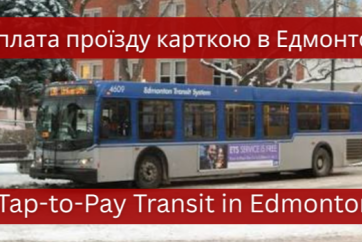
In 2025, traveling by public transport in Edmonton finally became a little easier: now you can simply tap your bank card, phone, or watch on Arc validators and go. No more small change, paper tickets, or rushing to buy a pass — the tap to pay system allows you to pay for your trip the same way you pay at the supermarket or coffee shop.
This is especially convenient for newcomers, tourists, and those who don't use public transportation every day: there's no need to immediately figure out Arc cards, passes, and refills. But there are some nuances that are important to know so you don't overpay.
What is tap to pay in Edmonton
Tap to pay in the public transport system is the ability to pay for your trip by tapping the reader with:
- a contactless debit or credit card (Visa, Mastercard, American Express, Interac), or
- a phone/smartwatch with Apple Pay, Google Pay, or another mobile wallet. All of this works through the same infrastructure as Arc: you tap your card/phone on the validator at the bus entrance or LRT station, and the system deducts the fare.
Where does tap to pay work?
Tap to pay is gradually being introduced across the entire network where Arc is used:
- ETS buses within Edmonton;
- LRT stations (Arc validators at the entrance to the fare zone);
- regional carriers with Arc (Fort Sask Transit, Strathcona County Transit, St. Albert, etc.).
Before traveling, check the latest information at myarc.ca or the city's website, where the list of carriers and stops that already support tap to pay is updated. Wikipedia
How much does it cost
The ETS system operates on a basic principle:
- there is a cash fare, which is more expensive;
- there is an Arc fare, which is cheaper than cash;
- there is also a transfer window (90 minutes) and fare capping (if you travel frequently, after a certain amount, you can travel for the rest of the month without additional charges).
Payment via tap to pay (by bank card or phone) is usually calculated as a single trip at the current adult fare, without Arc card discounts and without a monthly fare cap. It is best to check the exact amounts and rules in the Transit fares section on the city's website or at myarc.ca, as fares change from time to time.
How to use tap to pay: step by step
1. Prepare your card or phone
Make sure that:
- your card supports contactless payments (there is a “radio wave” symbol);
- you have enough funds on it;
- if you are paying by phone, your bank card is added to Apple Pay/Google Pay, and NFC is enabled.
2. Hold it up to the reader Arc
- On the bus — the validator is located near the front door next to the driver.
- On the LRT — validators are located in front of the entrance to the paid area or near the turnstiles.
Simply hold your card, smartphone, or watch up to the reader and hold it there for 1–2 seconds until:
- the green indicator lights up / “Approved” appears;
- a short beep sounds.
This means that the trip has been paid for.
3. Do not hold up multiple cards at once
If you also have a plastic card in your phone case or you are holding a wallet with a set of cards, the system may “read” the wrong one. It is better to:
- either tap one specific card,
- or pay with your phone/watch when all other cards are separate.
How tap to pay differs from the Arc card
Advantages of tap to pay
✅ No need to buy and top up an Arc card.
✅ Ideal for tourists, visitors to the city, or those who travel very rarely.
✅ Fast: tap your card and get on the transport.
Disadvantages compared to Arc
The Arc card has several strong bonuses:
-
Cheaper fare than cash (and usually cheaper than single trips).
-
90 minutes of transfers without extra charge within the region (buses + LRT).
-
Monthly fare capping — when you reach a certain amount per month, you can travel for free until the end of the period.
Tap to pay, as a rule:
- does not provide full monthly fare capping;
- can be more expensive if you travel daily or change buses frequently;
- makes it more difficult to track expenses if your family uses one card.
Who is better suited for tap to pay, and who is better suited for Arc
Tap to pay is convenient if:
- you have just arrived in Edmonton and are still figuring out the system;
- you use public transport 1-2 times a week or less;
- you are a tourist/visitor staying for a few days;
- you have lost your Arc card and need to make a one-time trip.
The Arc card is more advantageous if:
- you travel to work/school almost every day;
- you often transfer between buses and LRT;
- you want to use the monthly fare cap and not overpay.
Practical tips to avoid overpaying
- If you plan to travel regularly, get an Arc card and use tap to pay only as a backup option.
- For one-time trips (cinema, meeting in the city center, hospital), tap to pay is super convenient: just grab your card or phone and go.
- Keep track of your bank statements: this makes it easier to understand how much you are actually spending on transportation.
- If several people in your family use public transportation, it is better to get separate Arc cards instead of everyone using one bank card.
In short: tap to pay in Edmonton is the ideal option for “hassle-free travel,” but for daily public transport users, it is still more profitable to have your own Arc card. And it's best to know how both options work so that in any situation you can pay for your fare quickly, conveniently, and without unnecessary stress. Based on materials by Yulianna Voloshyna