
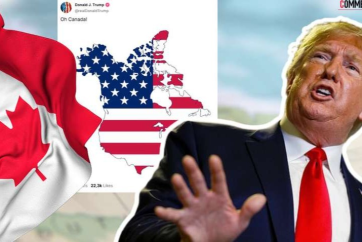
Following the recent US military intervention in Venezuela, the topic of American foreign policy has become a hot topic in Canada as well. A new poll by Leger showed that 31% of Canadians believe it is likely that the United States may attempt to take “direct action” to take control of Canada in the future.
Context: what triggered the discussion
The poll was conducted in the wake of news about the US intervention in Venezuela, which has been one of the most talked-about international stories in recent days. In particular, the media reported on US strikes against Venezuela, which provoked a strong reaction both in the region and among Western audiences.
Key survey results
According to Leger:
- 31% of Canadians consider the scenario of “direct action” by the US against Canada in the future to be likely.
- Among Americans, 20% consider this possibility.
- 65% of Canadians are following events surrounding the US-Venezuela conflict (roughly comparable to the level of attention in the US).
Furthermore, according to respondents, the risks of potential future US interventions (among those Canadians who generally consider such interventions likely) extend beyond Canada. The most frequently mentioned countries were:
- Greenland — 55%
- Cuba — 51%
- Colombia — 47%
- Panama — 47%
- Canada — 31%
How Canadians assess the intervention in Venezuela
The survey also reveals a noticeable difference in attitudes toward US actions:
- 53% of Canadians consider the intervention “bad” because it violates Venezuela's sovereignty and sets a dangerous precedent.
- 23% of Canadians consider it justified (argument: removal of a corrupt regime and a chance for better governance).
- Among Americans, 39% share this position.
When respondents were asked about the possible motive for the operation, 63% of Canadians cited control over Venezuela's oil resources as the main reason.
Separately, Leger notes that the intervention worsened attitudes toward the US government in Canada: 56% said their opinion had worsened (and only 9% said it had improved).
Methodology: who responded and when
Leger conducted an online survey of:
- 1,540 Canadian residents and 1,011 US residents aged 18+
- January 9–11, 2026
- Respondents were recruited through the LEO online panel, and the results were weighted according to demographic parameters (age, gender, region, language, education, etc.).
Important caveat: this is a panel (non-probability) online survey, so the classic “sampling error” does not directly apply to it (Leger only provides comparative calculations “if” it were a probability sample).
What this means in practice
These figures do not prove that such a scenario is realistic or imminent — rather, they show the level of anxiety and mistrust that has arisen in part of Canadian society after high-profile foreign policy events. This is also hinted at by the contrast in perceptions of the intervention: in Canada, the argument about sovereignty and precedent is much stronger, while in the US, the thesis of “justification” has more support.